
Kundli Matching Guide
What Are 36 Gunas in Marriage Matching? Meaning of Varna, Nadi, Bhakoot & More
A complete, practical guide to 36 Gunas in kundli matching. Understand all 8 kootas, score meanings, common myths, and how to make better marriage decisions with balance.
Introduction
In arranged marriage discussions, one of the first questions families ask is: how many gunas match? The number often creates instant confidence or instant fear. But the truth is more nuanced. A score is useful, yet not complete by itself.
The 36-guna system belongs to Ashtakoota Milan, a Vedic method that studies compatibility through eight dimensions. These dimensions include mindset, temperament, emotional harmony, biological compatibility, and long-term family flow.
This guide explains every koota clearly, including Varna, Nadi, Bhakoot, and the rest, so you can interpret scores correctly and avoid common misunderstandings.
What is 36 Guna Matching?
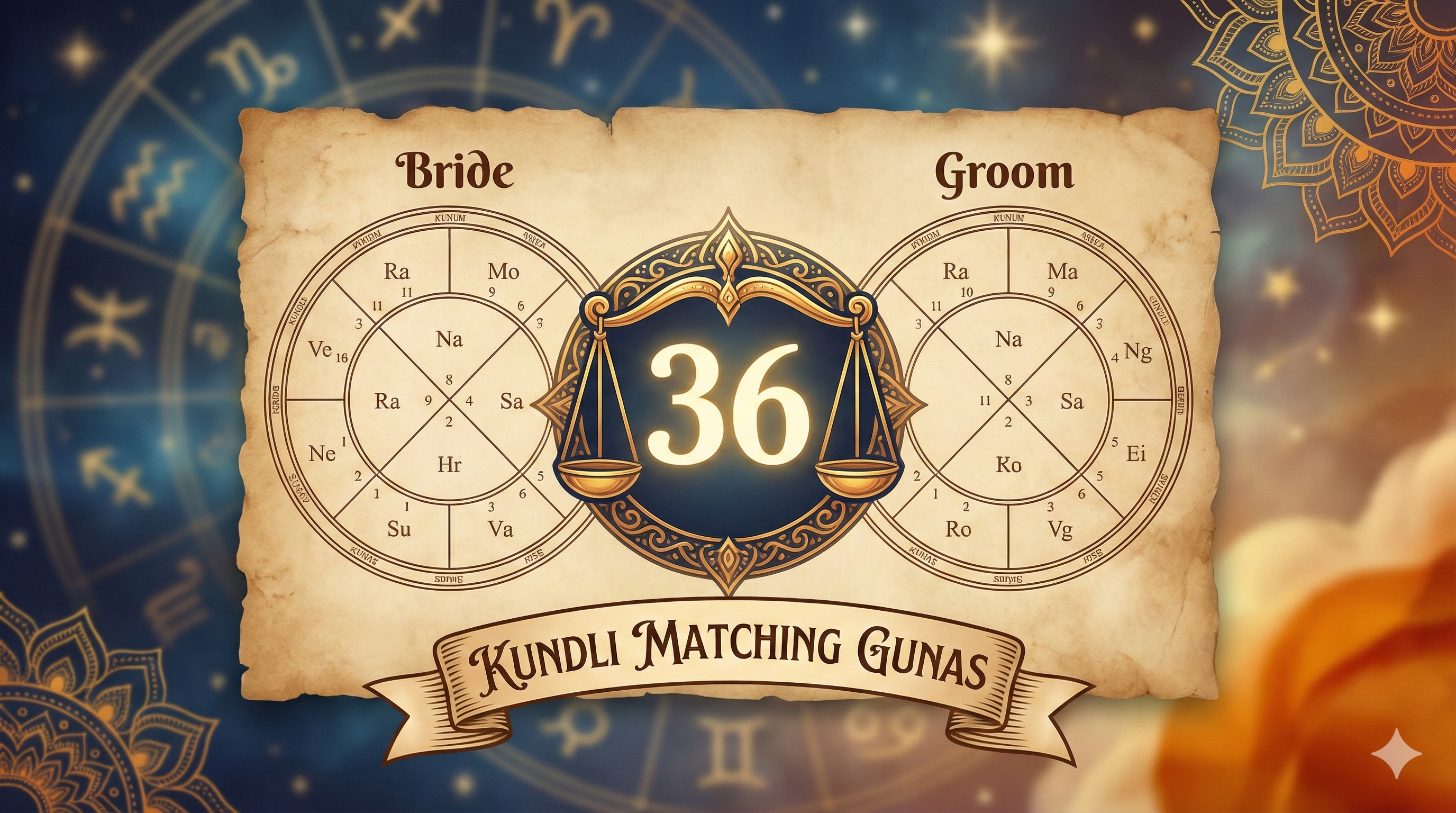
36 Guna matching is the total score produced by eight compatibility factors in Ashtakoota Milan. Each factor has a maximum weight, and the total possible score is 36.
The system is based primarily on Moon sign and Nakshatra matching. This is because Moon is linked with emotions, instinctive behavior, and mental response patterns, which are central to married life.
Traditionally, 18 is considered the minimum acceptable score, but practical judgment should include full chart analysis, dosha review, and real-life compatibility.
How the 36 Score is Interpreted
Common interpretation ranges are: below 18 (challenging), 18-24 (workable with effort), 24-32 (good compatibility), and 32+ (very strong score). These ranges are guidelines, not rigid laws.
A low total can happen due to one heavily weighted koota like Nadi or Bhakoot, while other dimensions may still be strong. Similarly, a high total can hide practical issues like ego clashes, communication immaturity, or financial mismatch.
The right approach is to read score plus structure: which kootas are weak, which are strong, and whether major chart factors support stability.
All 8 Kootas and Their Meaning
Here is the quick-reference table used in 36-guna matching:
| Koota | Max Points | Core Meaning |
|---|---|---|
| Varna | 1 | Spiritual / value alignment |
| Vashya | 2 | Mutual influence and adjustment |
| Tara | 3 | Wellbeing rhythm and support |
| Yoni | 4 | Intimacy and instinctive comfort |
| Graha Maitri | 5 | Mental friendship and thinking style |
| Gana | 6 | Temperament and behavior type |
| Bhakoot | 7 | Emotional and family harmony |
| Nadi | 8 | Health and biological compatibility |
Varna Koota Meaning (1 Point)
Varna koota reflects spiritual and psychological alignment. It is the least weighted factor, with a maximum of 1 point. Low varna score does not automatically indicate major marital risk.
In modern interpretation, this koota is seen as value-level compatibility: worldview, ethics, and lifestyle orientation. It should be considered, but not overemphasized.
Vashya Koota Meaning (2 Points)
Vashya represents mutual influence and relational balance. It checks whether one partner tends to dominate strongly or whether the pair can naturally cooperate.
A healthy vashya score supports smoother adjustment in daily life, while mismatch may require more conscious boundary and communication work.
Tara Koota Meaning (3 Points)
Tara koota is linked with wellbeing, fortune rhythm, and emotional steadiness between partners. It studies Nakshatra-based compatibility flow.
When tara alignment is better, couples often report better mutual support during stress cycles. Lower tara score suggests extra focus on resilience and emotional care.
Yoni Koota Meaning (4 Points)
Yoni koota relates to intimacy style, physical chemistry, and instinctive comfort. A stronger yoni match supports closeness and reduced friction in personal space.
Low yoni score does not doom a marriage, but it signals the need for patience, respect, and better emotional-physical communication.
Graha Maitri Meaning (5 Points)
Graha Maitri measures mental friendship and intellectual compatibility through lordship relationships of Moon signs. This koota has strong practical value in daily marriage life.
A good score here often supports better problem solving, shared planning, and calmer conflict recovery. Low score can still work if communication skills are intentionally built.
Gana Koota Meaning (6 Points)
Gana koota represents temperament type and behavioral style. It is one of the most noticeable compatibility indicators in day-to-day interaction.
Mismatch may show as differences in sensitivity, reaction speed, or emotional expectations. It does not mean failure, but it usually requires maturity and conscious adjustment.
Bhakoot Koota Meaning (7 Points)
Bhakoot has high weight and is linked with emotional bonding, family harmony, and long-term domestic flow. This is why Bhakoot mismatch often creates anxiety in families.
Still, Bhakoot dosha is not always absolute. Cancellation conditions and overall chart strength can reduce risk. Practical compatibility should always be checked alongside.
Nadi Koota Meaning (8 Points)
Nadi is the highest-weighted factor (8 points). Traditionally, it is associated with health rhythm, biological harmony, and family continuity.
Nadi dosha is often treated as serious, but classical and regional traditions include exceptions and cancellation rules. A complete chart reading is essential before final decisions.
Low Score: Is Marriage Not Possible?
No. A low score is a caution marker, not a final rejection stamp. It indicates areas needing awareness: emotional communication, conflict style, family boundary handling, and health/lifestyle discipline.
Many low-score couples build strong marriages when they approach compatibility as a skill set and not just a number. Counseling, transparent discussion, and realistic expectations matter greatly.
High Score: Is Success Guaranteed?
Also no. High score means structural compatibility is favorable, but success still depends on behavior. Ego battles, dishonesty, financial instability, and poor communication can damage even high-score matches.
Think of guna score as a starting advantage, not a permanent guarantee. Married life remains a daily practice.
What to Do If Scores Are Low
First, do not panic. Get a complete reading that includes dosha cancellation, 7th house condition, Venus/Jupiter strength, and dasha timing. Never decide based only on one screenshot score.
Second, evaluate practical alignment: values, career plans, family expectations, location plans, children decisions, and emotional maturity.
Third, if concerns remain, combine spiritual remedies with practical actions: counseling, conflict training, financial planning, and health-focused routine.
FAQs
Q1. Is 18/36 mandatory? Traditionally yes as a baseline, but it is not the only criterion in a responsible matching decision.
Q2. Which koota matters most? Nadi and Bhakoot have high weight, but final judgment depends on full-chart context and cancellation conditions.
Q3. Can 16 or 17 score still work? Yes, in some cases, when major chart factors are supportive and the couple is practically aligned.
Q4. Should love marriage couples check gunas? It is optional, but can help identify blind spots and improve relationship preparation.
Conclusion
36 Guna matching is a valuable framework when used correctly. It helps identify compatibility strengths and friction points early.
But no number alone can define marriage destiny. The best outcomes come from combining astrology with clear communication, emotional maturity, practical planning, and shared responsibility.
Use guna matching as guidance, not fear. That balanced approach leads to better decisions and healthier marriages. For deeper astrological insights, you can check your Free Kundli or read about Vedic Astrology.