
Kundli Matching Guide
Kundli Matching After 30: Does It Really Matter for Boys and Girls?
A practical and balanced guide on whether kundli matching still matters after age 30 for men and women, what changes with age, and how to make mature marriage decisions.
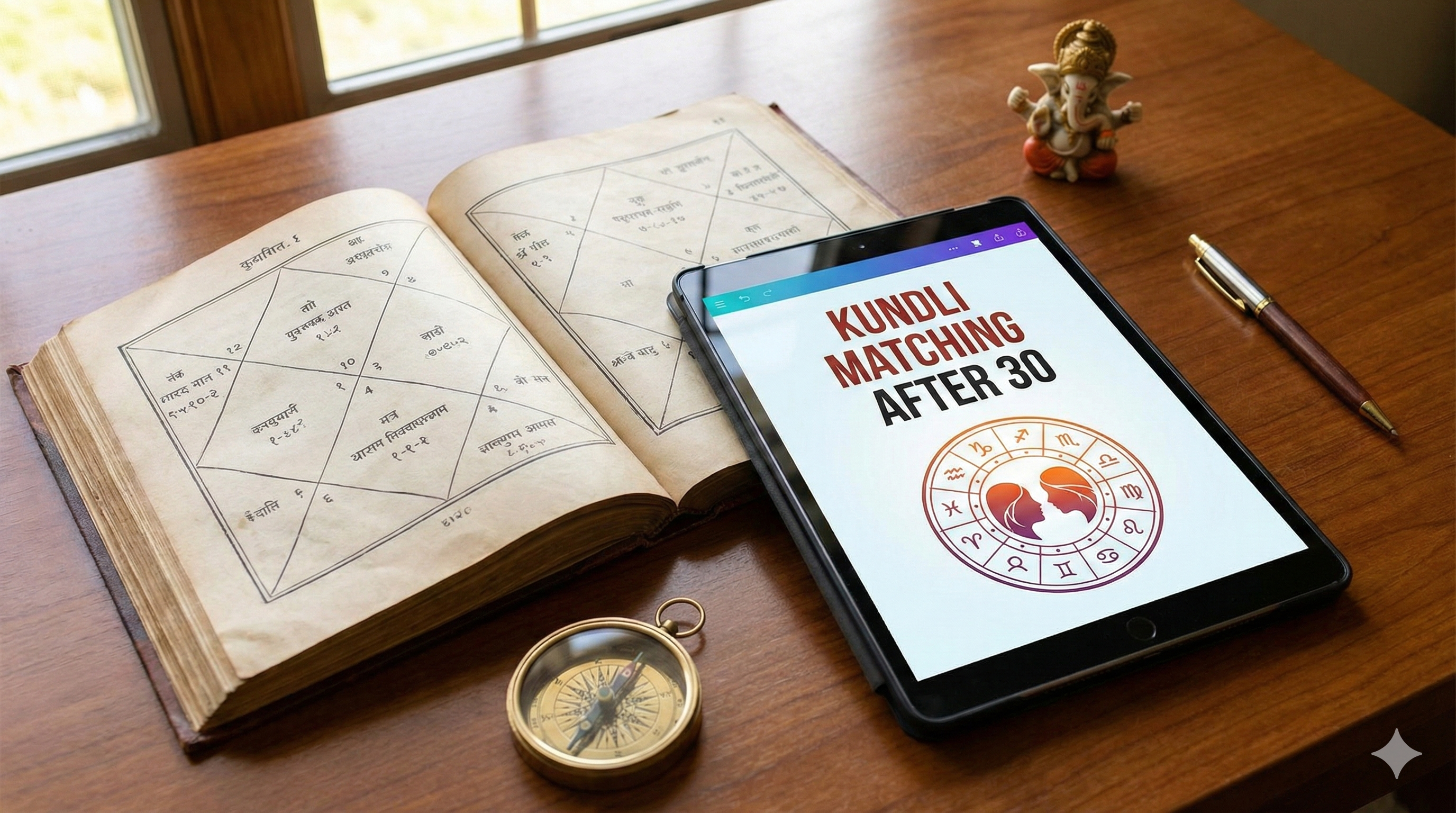
Introduction
Once people cross 30, marriage discussions become more practical and time-sensitive. Families and individuals often ask: does kundli matching still matter at this stage, or should we focus only on practical factors?
This is a valid question. At 30+, priorities are different from early twenties. Career, emotional maturity, family responsibilities, and past relationship experiences all shape decisions. So the role of kundli matching also needs a more mature interpretation.
The right answer is not extreme. Kundli matching is neither useless nor absolute. It can still help, but it should be applied with context and balance.
Why This Question Comes After 30
By 30, most people have a clearer identity and expectations from marriage. They are less interested in symbolic perfection and more focused on long-term peace, emotional trust, and life direction alignment.
At the same time, social pressure increases. Families may become anxious about timeline and start compromising either too much or too little. In this confusion, kundli matching is either ignored completely or treated as a rigid filter.
Both extremes create problems. The better route is to use kundli matching as a diagnostic tool that highlights possible friction areas, while practical compatibility decides actual feasibility.
Does Kundli Matching Still Matter After 30?
Yes, it can still matter after 30. Emotional compatibility, temperament, conflict style, and family harmony do not become irrelevant with age. In fact, these factors become more critical because people are more set in their habits.
Kundli matching helps identify where adjustment may be harder: communication pattern, emotional response, ego conflicts, health rhythm, and family integration. This foresight can prevent avoidable friction.
But it should not be used as the only decision-maker. A high score cannot guarantee a successful marriage, and a moderate score does not guarantee failure.
What Changes in Marriage Decisions After 30
After 30, decision quality depends more on clarity than on excitement. Practical points become non-negotiable: career location, finances, children planning, lifestyle compatibility, and emotional availability.
People usually carry stronger routines and independent identities. That means adjustment is possible, but only with conscious effort and respect. Superficial matching is not enough.
So while kundli remains useful, it should work alongside mature conversations and realistic planning.
Kundli Matching for Boys After 30
For men after 30, chart analysis can be useful in identifying work-life imbalance, emotional expression style, and tendency toward control or withdrawal under stress. These patterns heavily influence married life.
Many men at this stage are career-focused and may underestimate emotional communication. Kundli indicators around Moon, Venus, and seventh-house dynamics can provide valuable self-awareness.
The real value is not in rejecting proposals quickly, but in understanding what effort areas are needed for a stable marriage.
Kundli Matching for Girls After 30
For women after 30, compatibility assessment often includes career continuity, emotional safety, family expectations, and mutual respect for personal identity. Kundli insights can support better clarity on these dimensions.
At this stage, emotional maturity is usually stronger, but tolerance for unhealthy dynamics is lower. That is healthy. Kundli matching can help identify potential stress points before commitment.
The key is empowerment, not fear. Use astrology to ask better questions, not to accept pressure.
Guna Score vs Real-Life Compatibility
A common mistake is over-focusing on total guna score. The number matters, but the pattern matters more. Which kootas are weak? Is there strong Graha Maitri but weaker Nadi? Is Bhakoot issue canceled in full-chart context?
Real-life compatibility includes communication style, conflict behavior, money habits, family boundaries, and willingness to grow. These factors can make or break marriage irrespective of score.
So treat score as a signal, not a verdict.
What to Prioritize Beyond Just Score
After 30, these factors should be explicitly discussed before engagement: emotional regulation, financial planning, location flexibility, children expectations, caregiving responsibilities, and lifestyle values.
Also evaluate psychological readiness: can both people handle disagreement respectfully? Can they communicate without blame? Are they aligned on long-term life pace?
When practical alignment is strong, even moderate astrological mismatches can be managed with maturity.
Common Mistakes Families Make
Mistake one: rejecting good proposals due to minor dosha without full context. Mistake two: accepting weak practical compatibility because score looks high. Mistake three: rushing decisions due to age pressure.
Another mistake is hiding difficult conversations until after engagement. This creates avoidable shocks later. Transparency is always better than late adjustment.
A responsible process should combine astrological guidance with open communication and practical due diligence.
A Balanced Matching Approach
Step 1: Do complete matching, not only 36-score screenshot. Step 2: Review major doshas with cancellation rules. Step 3: Conduct practical compatibility discussions honestly.
Step 4: If needed, involve counseling before final commitment. Step 5: Use remedies as supportive practices, not substitutes for behavior change.
This blended model works best after 30 because it respects both tradition and modern relationship realities.
FAQs
Q1. Is kundli matching compulsory after 30? It is not legally compulsory, but it can be useful for clarity if used with balance.
Q2. Can low guna score still work after 30? Yes, if practical compatibility and emotional maturity are strong.
Q3. Should boys and girls be judged differently in kundli matching? No. Core compatibility principles are equal for both; context should be fair and practical.
Q4. Is age 30+ too late for astrological matching? No. Matching remains relevant at any age when interpreted responsibly.
Conclusion
Kundli matching after 30 still has value, but only when used intelligently. It should support decision-making, not create fear or unnecessary rejection.
For both boys and girls, the best results come from combining astrology, emotional maturity, and practical alignment. Marriage success is built by people, not only by scores.
If you treat kundli as guidance and not pressure, it can help you choose with clarity and confidence. For deeper astrological insights, you can check your Free Kundli or read about Vedic Astrology.